Podling Teaclave Report - August 2021

Mingshen Sun

Teaclave

Teaclave is a universal secure computing platform, making computation on privacy-sensitive data safe and simple.

Teaclave has been incubating since 2019-08-20.

Three most important unfinished issues to address before graduating:

  • Improve project structure and documentation
  • Grow the community (attracting more committers, contributors, users)
  • Publish Apache releases (resolving logistics on Apache release)

Are there any issues that the IPMC or ASF Board need to be aware of?

None.

How has the community developed since the last report?

Since the last report, we have organized three monthly virtual meetups. Many people from the community share their usage experience of Teaclave. Also, we invited some contributors to talk about some technical details of the design and implementation. For each meetup, we have minutes write-up published on the Teaclave blog.

We also have two new members:

  • 2021-07-09, Hongbo Chen (ya0guang), Commiter
  • 2021-07-25, Gordon King (garyw), Mentor

How has the project developed since the last report?

Here are the summaries of recent progress of our three sub-projects:

Teaclave:

  • Change the executor's payload type from String to Vec<u8>.
  • Unify the launch of teaclave services.
  • Add WebAssembly Executor and corresponding examples.
  • Upgrade Intel SGX SDK to the latest release (SGX 2.14.100.2, DCAP 1.11.100.2).
  • Some minor fixes of the building system and documentation.

Teaclave SGX SDK:

  • Minor bug fixes.

Teaclave TrustZone SDK:

  • Release the first Apache Incubator version 0.1.0: Announcing Apache Teaclave TrustZone SDK (Incubating) 0.1.0.
  • Update to OP-TEE 3.13.0.
  • Implement the iSocket APIs and corresponding examples.
  • Implement loadable plugin for TA and corresponding examples.
  • Some minor fixes and repository cleanups.

How would you assess the podling's maturity?

Please feel free to add your own commentary.

  • Initial setup
  • Working towards first release
  • Community building
  • Nearing graduation
  • Other:

Date of last release:

2021-06-10: Apache Teaclave TrustZone SDK (incubating) 0.1.0

When were the last committers or PPMC members elected?

2021-07-25, Gordon King (garyw), Mentor

Have your mentors been helpful and responsive?

Yes, our mentors work responsively to help us with electing new mentors, proposing new features, and expanding the community.

Is the PPMC managing the podling's brand / trademarks?

We don't find any 3rd parties incorrectly using the podling's name and brand. The VP, Brand has approved the project name. (PODLINGNAMESEARCH-175)
Teaclave Meetup #6

Mingshen Sun

In July 29, we gathered on Zoom for the sixth Teaclave meetup. In the meetup, we announced our new mentor Gordon and invited Gordon to introduce the latest effort on integrating Graphene into Teaclave.

Teaclave Meetup #6

Schedule

  • Recent update of Teaclave, Mingshen (5m)
  • Introduction to Graphene, Gordon

Notes

Teaclave Meetup #5

Mingshen Sun

In Jun 24, we gathered in Zoom for the fifth monthly Teaclave meetup. In this meetup, we're glad to have Hongbo (@ya0guang) talking about his contributions on adding WebAssembly Micro Runtime to Teaclave as an executor (PR: #504, #512).

Teaclave Meetup #5

Schedule

  • Recent update of Teaclave, Mingshen (5m)
  • Executing WebAssembly in Teaclve, Hongbo (40m)
  • Open discussion

Notes

Recent Update of Teaclave

Teaclave TrustZone SDK version 0.1.0 released

Linaro OP-TEE Contributions meeting

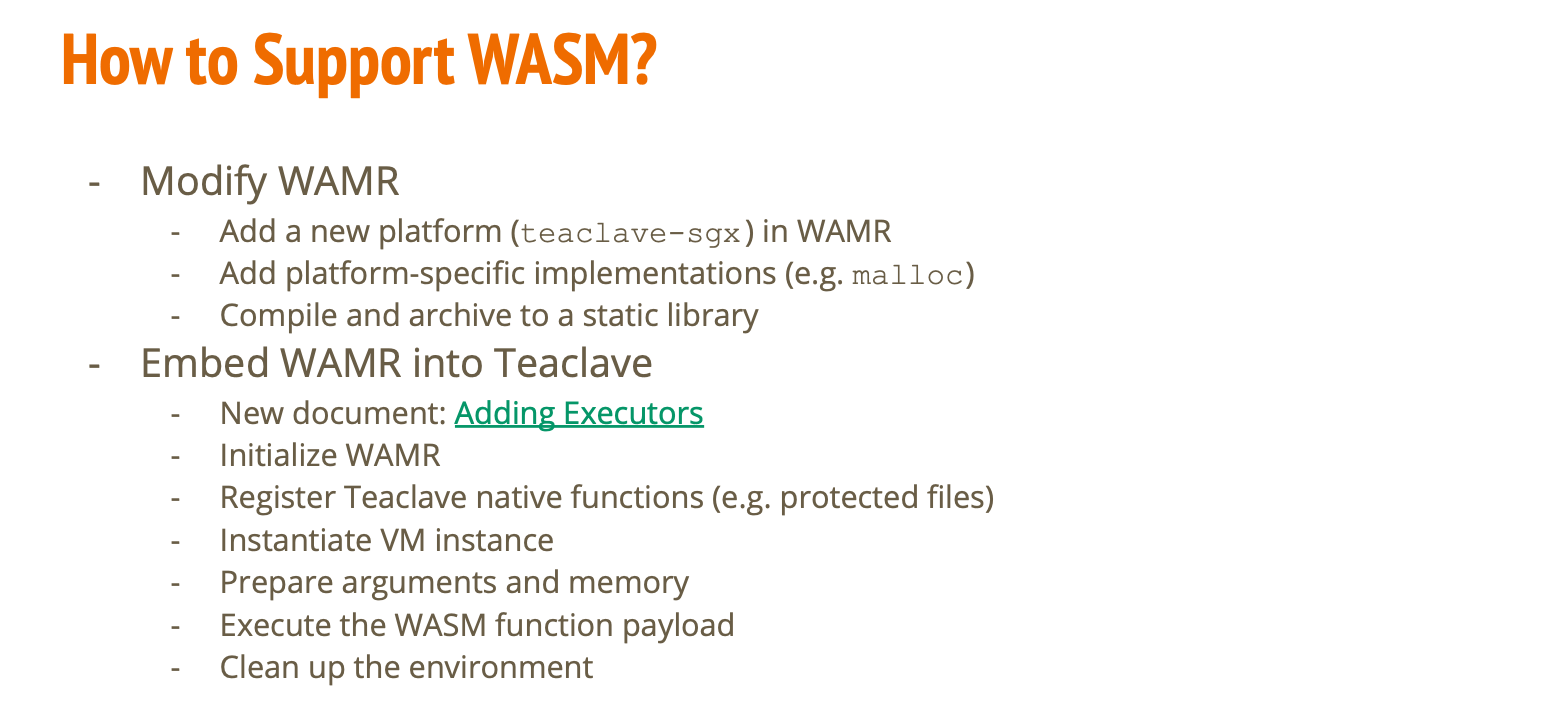
Executing WebAssembly in Teaclave

Executing WebAssembly in Teaclave

Some question and discussion:

  • Can we reuse the WebAssembly runtime to improve the performance of startup?
  • Bridging tlibc functions into WAMR.

Open Discussion

Announcing Apache Teaclave TrustZone SDK (incubating) 0.1.0

Mingshen Sun

On behalf of the Teaclave community, I am happy to announce the release of Teaclave TrustZone SDK 0.1.0. This is the first Apache Incubator release since the recent donation to the Teaclave community.

Teaclave TrustZone SDK provides abilities to build safe TrustZone applications in Rust. The SDK is based on the OP-TEE project which follows GlobalPlatform TEE specifications and provides ergonomic APIs. In addition, it enables capability to write TrustZone applications with Rust's standard library and many third-party libraries (i.e., crates). Teaclave TrustZone SDK is a sub-project of Apache Teaclave (incubating). To learn more about the design and history of TrustZone SDK, please read the blog Welcome Rust OP-TEE TrustZone SDK To Teaclave.

Highlights

This version implements the following Rust APIs in GlobalPlatform TEE specifications:

TEE Client API (optee-teec)

  • Context
  • Error
  • Operation
  • Parameter
  • Session
  • UUID

TEE Internal Core API (optee-utee)

  • Arithmetical
  • Crypto Operation
  • Error
  • Object
  • Parameter
  • Time
  • Trace

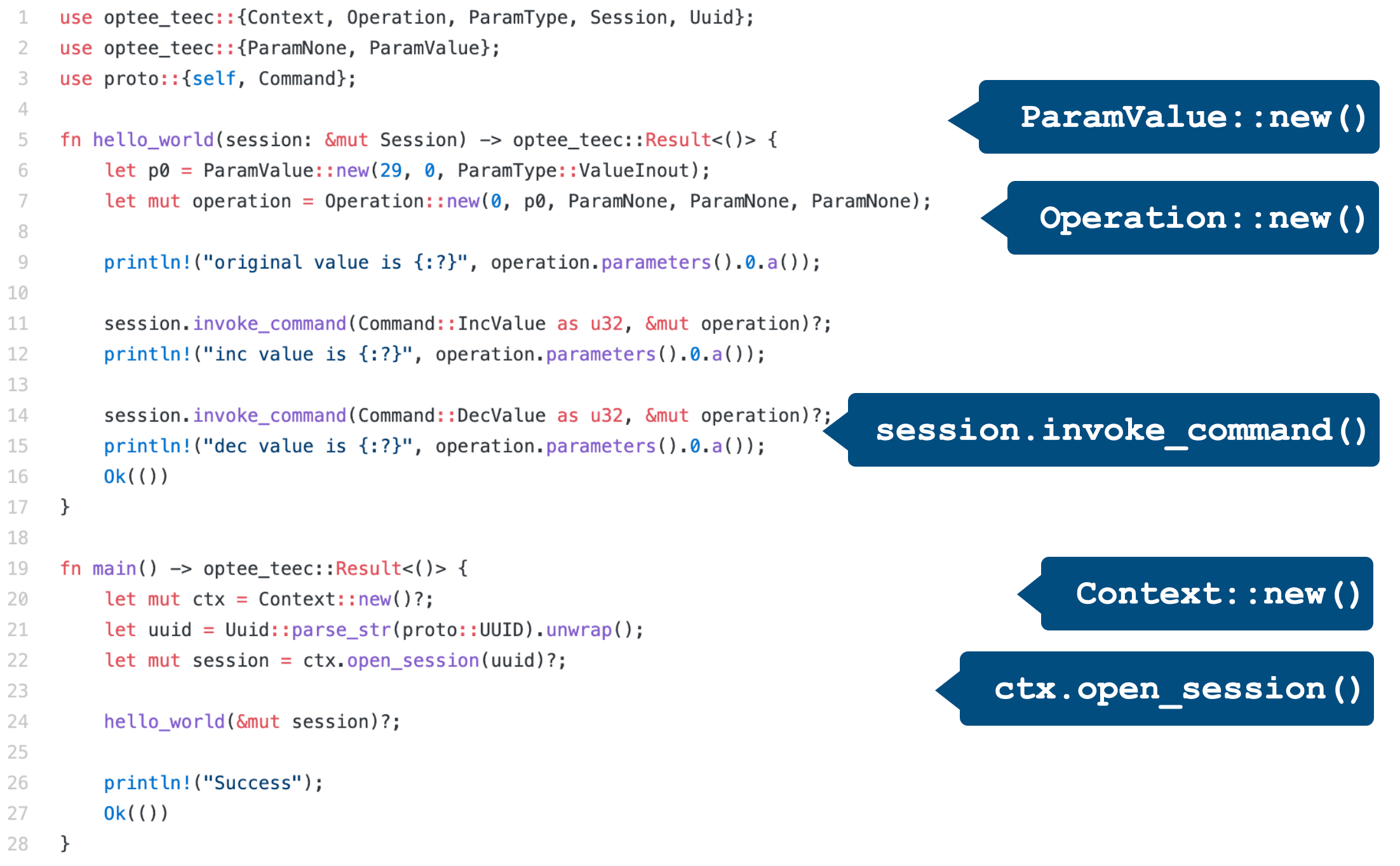
Here is a demonstration of using these Rust APIs to open a session and invoke a function to TA.

Teaclave TrustZone SDK APIs

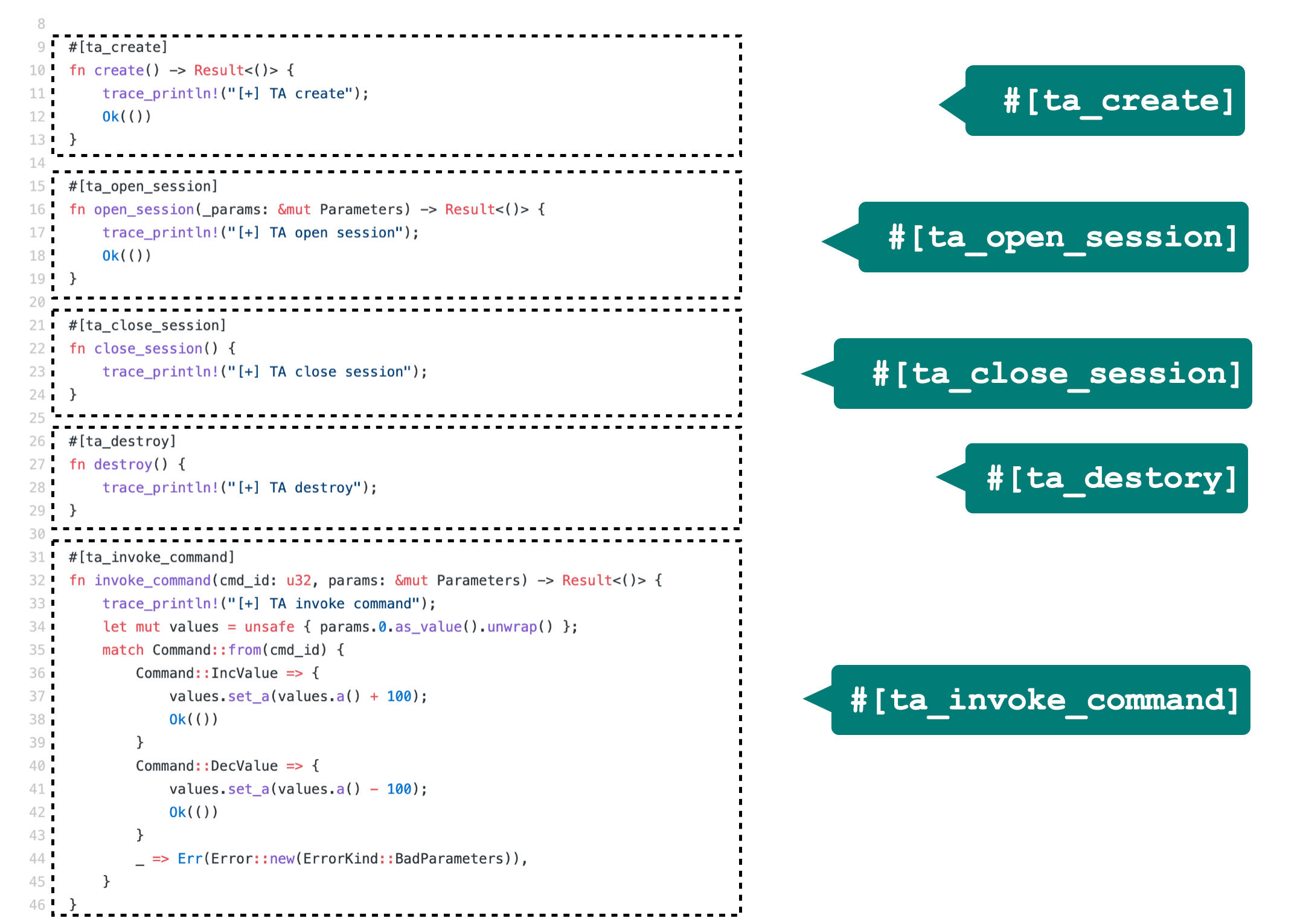
We also provides procedure macros to automatically generate bindings interfaces of TA:

  • #[ta_create], #[ta_destroy], #[ta_open_session], #[ta_close_session], #[ta_invoke_command]

These annotations will automatically generate helper functions to bridge the normal/secure worlds.

Teaclave TrustZone SDK Macros

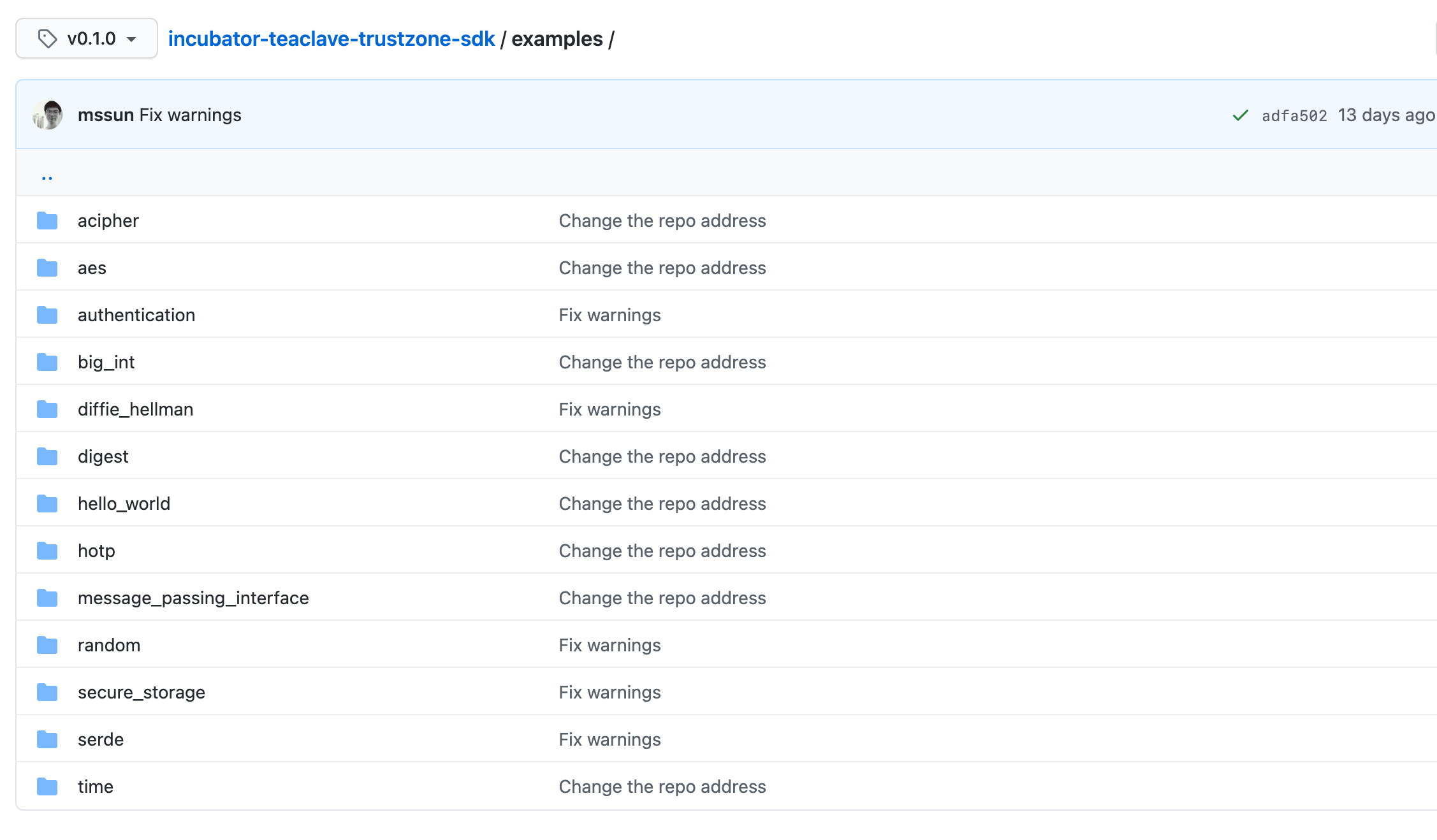
This version includes rewrites of all examples (e.g., AES, authentication, big integer, HOTP) from OP-TEE repository. In addition, we include more examples using serde for serialization and deserialization.

Examples in Teaclave TrustZone SDK

This version is compatible with OP-TEE 3.13.0.

Getting Started

Here is a simple instruction to download, build and test the TrustZone SDK:

$ wget https://dist.apache.org/repos/dist/dev/incubator/teaclave/trustzone-sdk-0.1.0-rc.1/apache-teaclave-trustzone-sdk-0.1.0-rc.1-incubating.tar.gz
$ tar zxvf apache-teaclave-trustzone-sdk-0.1.0-rc.1-incubating.tar.gz && cd
apache-teaclave-trustzone-sdk-0.1.0-incubating

$ # Instructions to verify the source tar:
https://teaclave.apache.org/download/#verify-the-integrity-of-the-files

$ # Building
$ docker run --rm -it -v$(pwd):/teaclave-trustzone-sdk -w
/teaclave-trustzone-sdk teaclave/teaclave-trustzone-sdk-build:0.1.1
bash -c "source environment && make"

$ # Testing
$ docker run --rm -it -v$(pwd):/teaclave-trustzone-sdk -w
/teaclave-trustzone-sdk teaclave/teaclave-trustzone-sdk-build:0.1.1
bash -c "source environment && cd ci && ./ci.sh"

We also provide a document Getting Started with OP-TEE for QEMU ARMv8 to get started step by step.

Download

You can download the release from the download page. Also, please checkout our repository hosted on GitHub.

Contributing

Teaclave TrustZone SDK is under the Apache License v2 and open source in The Apache Way. We aim to create a project that is maintained and owned by the community. All kinds of contributions are welcome. Thanks to our contributors.

Accepting Rust OP-TEE TrustZone SDK to Apache Teaclave (incubating) Proposal

The Teaclave PPMC

Abstract

Rust OP-TEE TrustZone SDK provides abilities to build safe TrustZone applications in Rust. The SDK is based on the OP-TEE project which follows GlobalPlatform TEE specifications and provides ergonomic APIs. More information can be found at the project repository: https://github.com/sccommunity/rust-optee-trustzone-sdk.

Proposal

Rust OP-TEE TrustZone SDK provides abilities to build safe TrustZone applications in Rust.

Background

The Rust OP-TEE TrustZone project is being actively developed within Baidu. It was open source on Jan 30, 2019.

Rationale

ARM TrustZone is another hardware trusted execution environment implementation. The goal of Teaclave is to provide a universal secure computing platform which is agnostic with TEE implementation. Currently, Teaclave has Teaclave SGX SDK and only supports Intel SGX. With the Rust OP-TEE TrustZone SDK, we can build the Teaclave platform on ARM TrustZone.

Initial Goals

  • Transfer repository to the Apache Incubator under the Teaclave project
  • Code cleanup and more documentation

Meritocracy:

The Rust OP-TEE TrustZone SDK project was originally developed by Shengye Wan and Mingshen Sun within Baidu. The project now has new committers from around the world. Some open source projects like https://github.com/veracruz-project are using the SDK to build their systems. We encourage everyone to ask questions and create pull requests to the project.

Community:

We see several open source projects which are using the SDK for development. Also, we already receive contributions from external comitters. The community is growing overtime.

Core Developers:

The core developers are:

  • Shengye Wan (simonsywan at gmail dot com)
  • Mingshen Sun (mssun at apache.org)

Alignment:

The project is a complimentary of Teaclave's TEE backends.

Known Risks

An exercise in self-knowledge. Risks don't mean that a project is unacceptable. If they are recognized and noted, then they can be addressed during incubation.

Project Name

Since the project will be accepted as a subproject in Teaclave, the project is renamed to Teaclave TrustZone SDK.

Inexperience with Open Source:

One of the core developers, Mingshen Sun is from the Teaclave community. He's familiar with The Apache Way for the open source community.

Length of Incubation:

The project will be in incubation with Apache Teaclave (incubating) project.

Documentation

Initial Source

Source and Intellectual Property Submission Plan

We will submit a Software Grant for this project later.

External Dependencies:

The dependencies have Apache compatible license, which is provided under the BSD 2-Clause license.

Cryptography:

N/A

Required Resources

Mailing lists:

The project shares the same mailing list of Teaclave.

Git Repositories:

Issue Tracking:

Same with Teaclave.

Other Resources:

N/A

Initial Committers

  • Mingshen Sun (mssun at apache dot org)
  • Shengye Wan (simonsywan at gmail dot com)

Teaclave Meetup #4

Mingshen Sun

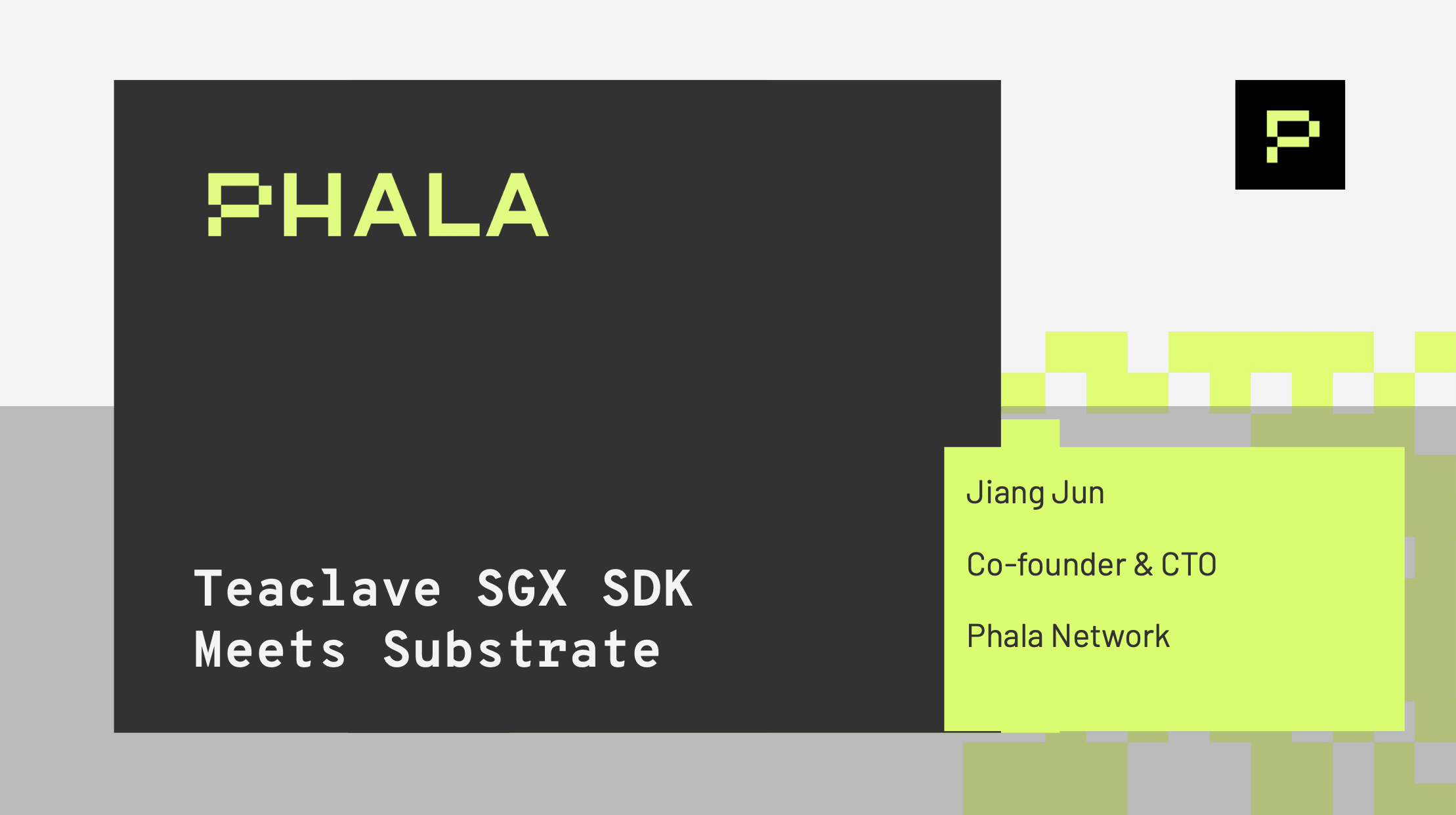
In April 29, we gathered in Zoom for the third monthly Teaclave meetup. In this meetup, we're glad to have Jiang Jun from Phala Network to give a talk on Taclave SGX SDK meets Substrate. Phala Network is a decentralized confidential computing cloud with tech stack includes Teaclave SGX SDK and Substrate.

Phala Network

In the meetup, we discuss use cases, technical details and implementation of Phala Network, as well as some difficulties with current version of Teaclave SGX SDK.

We are continuing work with out community together to improve the projects. Hopefully, more users and developers can join in our community and share your experience.

Teaclave Meetup #4

At last, if you are interested in our meetup, please subscribe our mailing list for the latest schedule of meetups.

Podling Teaclave Report - April 2021

Mingshen Sun

Teaclave

Teaclave is a universal secure computing platform, making computation on privacy-sensitive data safe and simple.

Teaclave has been incubating since 2019-08-20.

Three most important unfinished issues to address before graduating:

  • Improve project structure and documentation
  • Grow the community (attracting more committers, contributors, users)
  • Publish Apache releases (resolving logistics on Apache release)

Are there any issues that the IPMC or ASF Board need to be aware of?

None.

How has the community developed since the last report?

Since the last report, we have started monthly virtual meetups for three times. Many people from the community share their usage experience of Teaclave. Also, we invited some contributors to talk about some technical details of the design and implementation. For each meetup, we have minutes write-up published on the Teaclave blog.

In addition, we have one more project (Crust Network) powered by Teaclave joined in our "Powered By" page on the Teaclave homepage.

How has the project developed since the last report?

During this period, we also accepted the Rust OP-TEE TrustZone SDK project to Teaclave as a sub-project, named as Teaclave TrustZone SDK. Similar to Teaclave SGX SDK, Teaclave TrustZone SDK will be the foundation of the Teaclave FaaS platform to support multiple trusted execution environments.

We published a project roadmap in 2021:

We also announce the 0.2.0 release. In 0.2.0, we focus on various components including built-in functions, SDKs in different languages, docker, command line interface, documents, etc.

How would you assess the podling's maturity?

Please feel free to add your own commentary.

  • Initial setup
  • Working towards first release
  • Community building
  • Nearing graduation
  • Other:

Date of last release:

2021-03-02: Apache Teaclave (incubating) 0.2.0

When were the last committers or PPMC members elected?

2020-10-22, Ran Duan (rduan), Committer

Have your mentors been helpful and responsive?

Yes, our mentors work responsively to help us with accepting new project donation into Teaclave.

Is the PPMC managing the podling's brand / trademarks?

We don't find any 3rd parties incorrectly using the podling's name and brand. The VP, Brand has approved the project name. (PODLINGNAMESEARCH-175)
Teaclave Meetup #3

Mingshen Sun

In March 25, we gathered in Zoom for the third monthly Teaclave meetup. In this meetup, we're glad to have two speakers talking about some initial progress of Teaclave verification and comparison of public cloud attestation services.

Teaclave Meetup #3

Schedule

  • Recent Update of Teaclave, Mingshen (3m)
  • Teaclave Verification, Sean (15m)
  • Comparison of Public Cloud Attestation Services, Mengyuan Li (45 m)

Teaclave Verification

In this session, Sean talked introduced the plan of Teaclave verification. The main ideas is to create formal descriptions, specifications, and proofs for some core components of Teaclave.

The initial effort on this field is trying to formally describe the access control module in Teaclave. And then prove it with requirements defined in Common Criteria for Information Technology Security Evaluation. The security objective of access control module is to prevent unauthorized users from accessing the critical data through tasks and functions. By achieving the security objective, the threats of runtime tasks and functions abuse are eliminated under the assumptions identified in security problem definition. With these objectives, we can find some corresponding requirements in Common Criteria, e.g., FIA_UAU.2 for user authentication before any action.

The initial work has been accepted as a separate project in Teaclave. If you are interested in this topic, please see https://github.com/apache/incubator-teaclave-verification to learn more.

Comparison of Public Cloud Attestation Services

Then, Mengyuan talked his recent research on attestation, especially, on public cloud attestation services.

Public Cloud Attestation Services

Here the abstract of the talk:

Confidential computing is an emerging security feature provided by more and more public cloud service providers (e.g., Amazon AWS, Microsoft Azure, and Google Cloud) in order to help customers protect their sensitive data in the cloud environment. Some popular confidential computing services include Intel Software Guard Extensions (SGX) enclaves and AMD Secure Encrypted Virtualization (SEV) VMs. These services are usually atop different hardware-based Trusted Execution Environments (TEE) technologies.

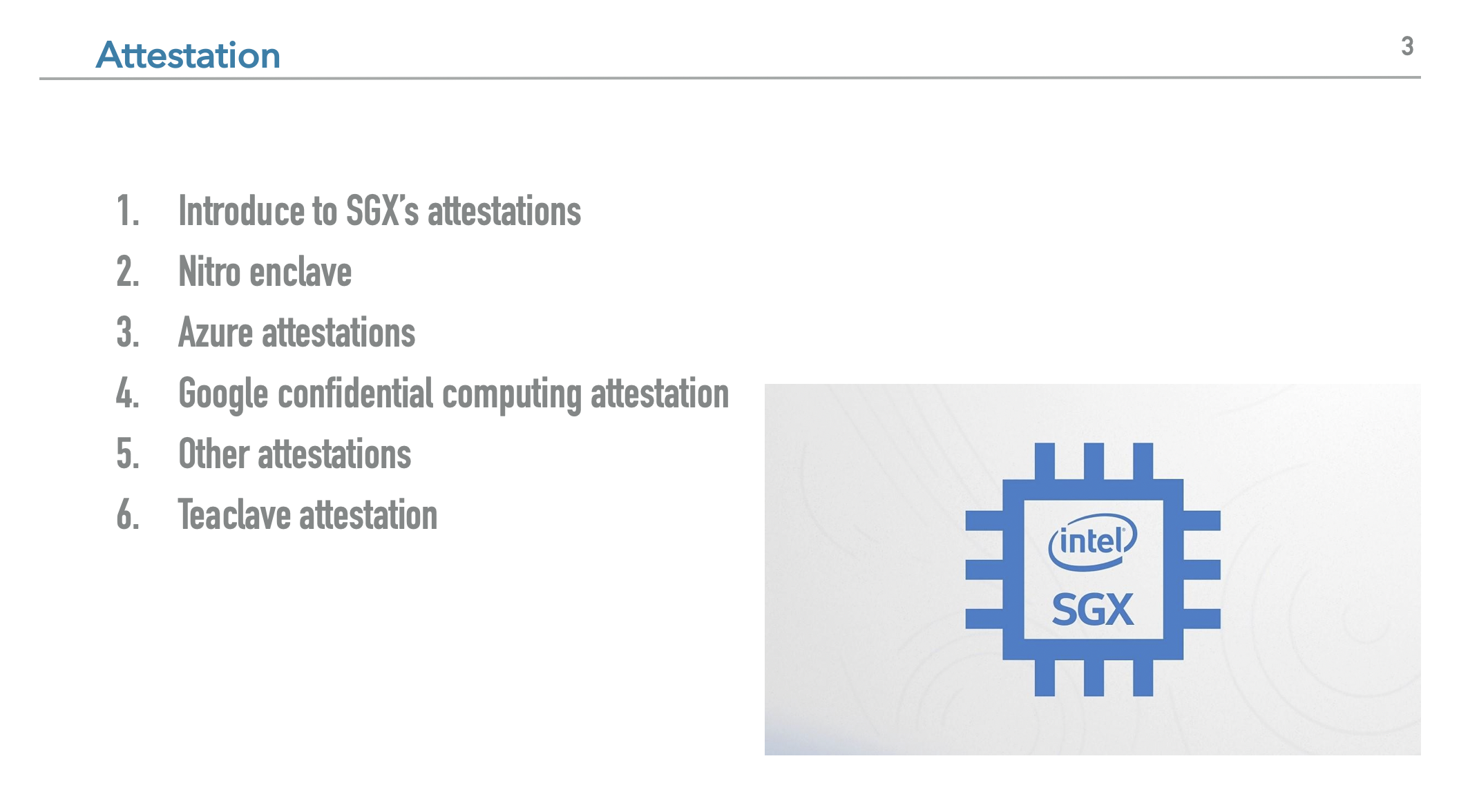
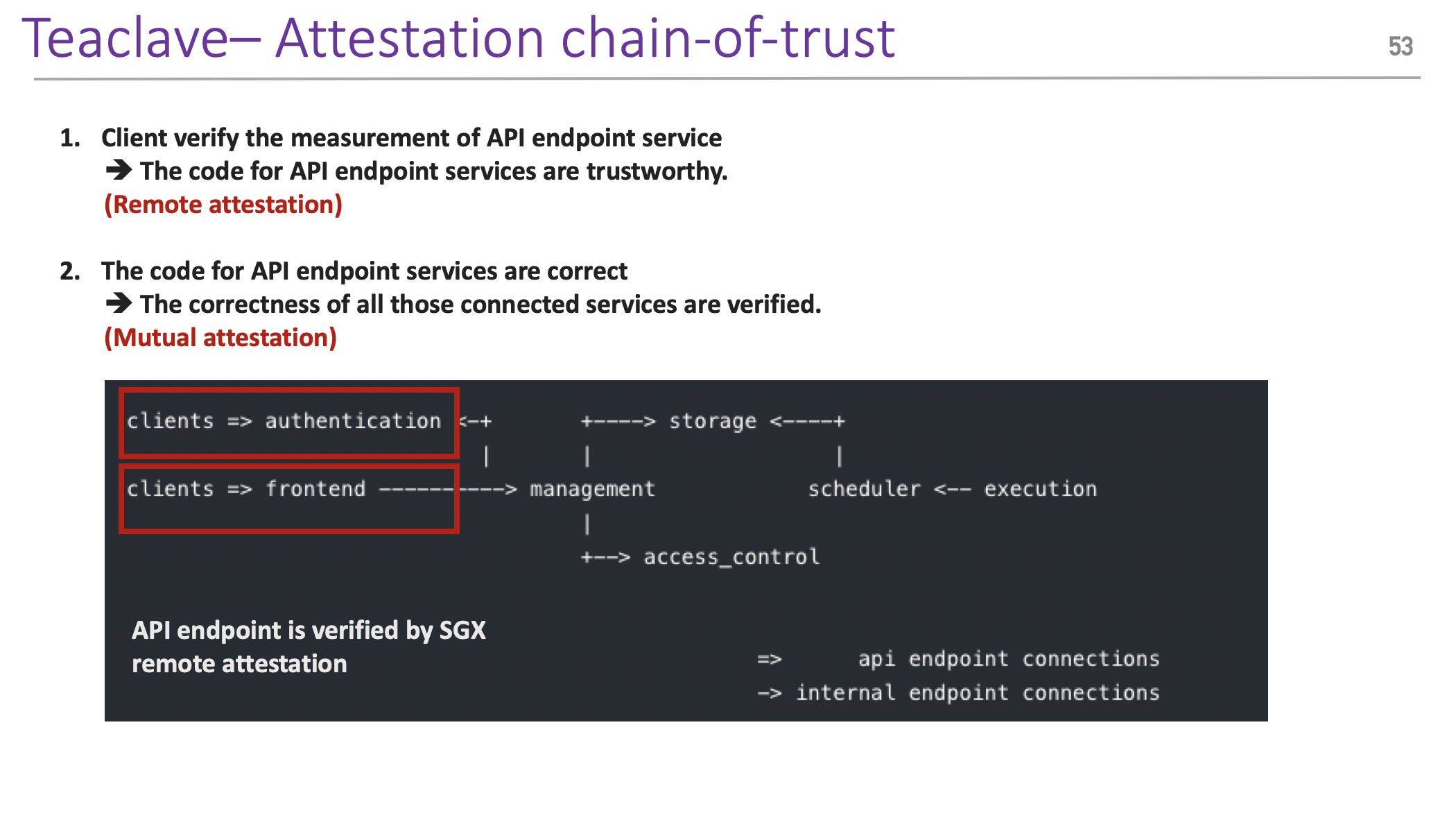
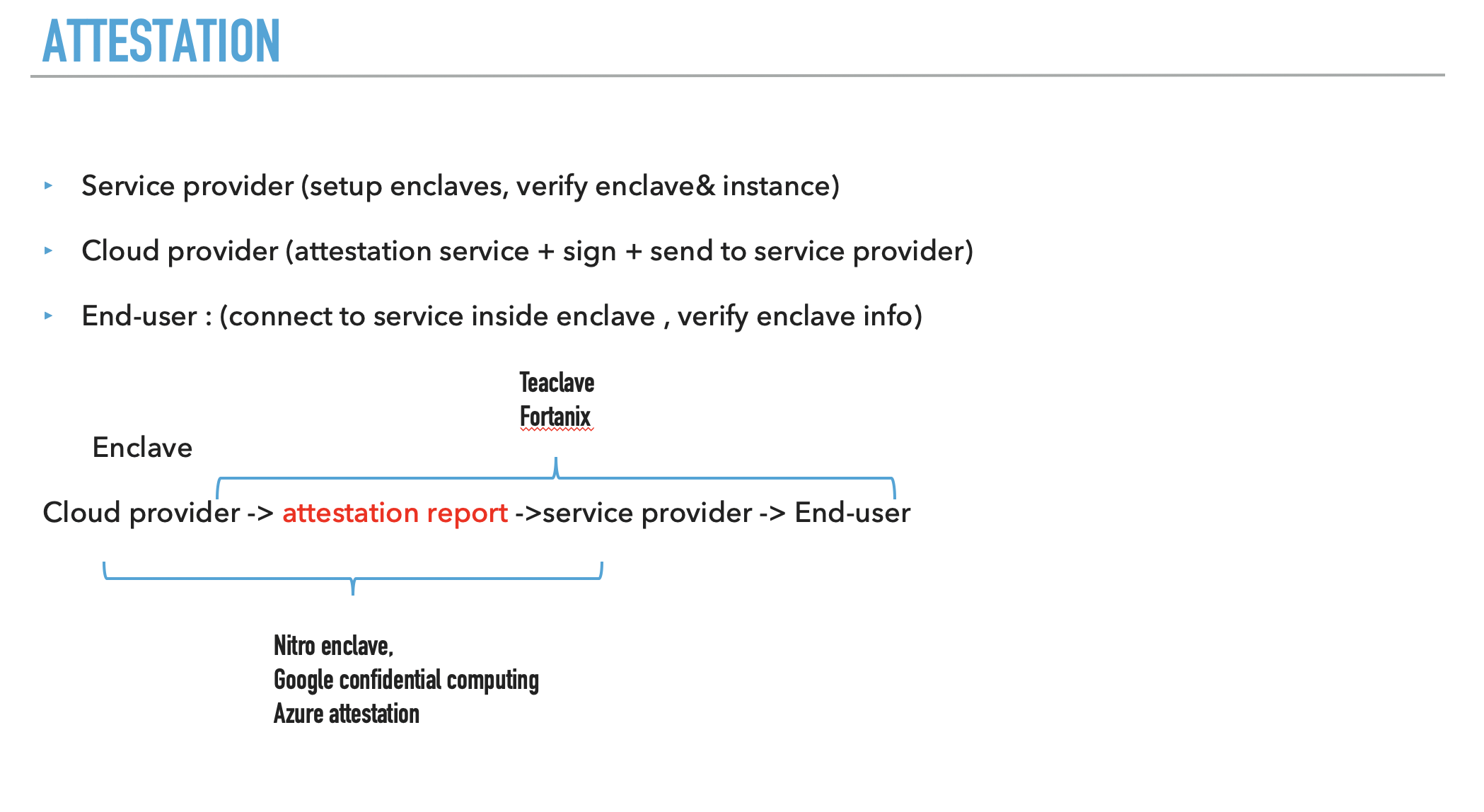
Meanwhile, to help convince the customers the trustworthiness of the platform hardware and the integrity of codes inside the TEE, cloud services providers also offer remote attestation services. In this talk, we will first cover the remote attestation workflow provided by some famous cloud TEE services, including Azure Open Enclave, Nitro Enclave, Google confidential computing VM and Fortanix. From the perspective of customers, we also focus on the attestation reports the customers can get. We then introduce Teaclave's current attestation design and discuss the attestation report standard Teaclave should follow.

He also discussed the attestation design of Teaclave.

Public Cloud Attestation Services of Teaclave

In the end, he also summarized the roles in the attestation ecosystem and positions of services/products discussed in this talk.

Public Cloud Attestation Services Summary

At last, thanks for attending this meetup. I'll continue to drive this meetup and make it a monthly activity for the community. If you want to speak in the next time, please post your proposed topic in the mailing list. I'll help you to schedule the time.

欢迎 Rust OP-TEE TrustZone SDK 成为 Teaclave 子项目

Mingshen Sun

English | 中文

TrustZone 为手机、嵌入式设备、云计算等 ARM 生态提供安全的可信执行环境,用于包括 安全支付、密钥管理、模型保护等场景。但是由于内存安全问题,TrustZone 中运行的安全 应用 (trusted application 或叫 TA) 的安全性大打折扣。 例如高通 QSEE 内存安全问题 [1] 造成的安全世界(secure world) 的漏洞, 后果甚至可以拿到全磁盘加密的密钥 [2]。

2019 年初百度开源了 Rust OP-TEE TrustZone SDK,为当今广泛使用的开源 TrustZone 实 现 OP-TEE 提供了一套内存安全使用方便的 SDK。SDK 基于 GlobalPlatform 的 TEE 标准,为开发者提供标准的开发接口。除此之外 Rust OP-TEE TrustZone SDK 支持 标准库第三方库,提高了 TA 的开发速度,并扩展了 TrustZone 的应用场景。

为了加速隐私安全生态发展,完善 TrustZone 的技术基础设施,百度在 2021 年初正式把 项目捐赠给 Apache 基金会,作为 Teaclave 的子项目之一,同时更名为 Teaclave TrustZone SDK,新的项目代码库地址为: https://github.com/apache/incubator-teaclave-trustzone-sdk 。Teaclave TrustZone SDK 与 Teaclave SGX SDK 一样,可以为 Teaclave FaaS 隐私安全 计算平台提供底层支持,赋能多平台可信执行环境的隐私安全计算生态。

Teaclave TrustZone SDK 设计和实现

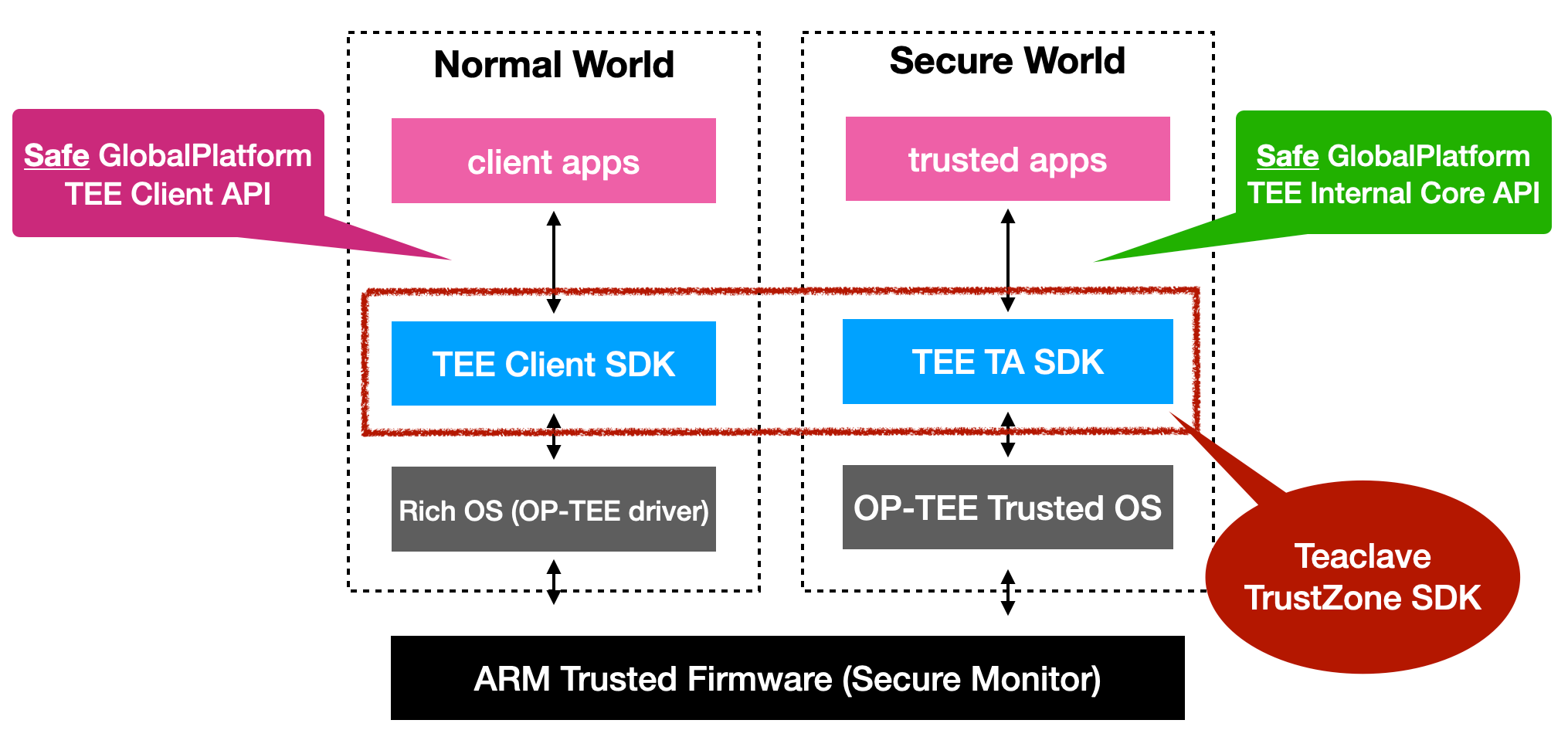
Teaclave TrustZone SDK 在 GlobalPlatform 标准的 API 上重新设计了安全的 Rust 接口, 使用 Rust 编写 TA(图中的 trusted apps)和 app(图中 client apps)能够大大减少内 存安全问题,确保可信执行环境的安全。

Teaclave TrustZone SDK Design

通过使用 Rust 的过程宏(procedure macro)自动生成边界代码,减少了开发中不必要的 负担,并且能够避免开发中因为粗心造成的安全问题。如下图所示,只需要在相应的函数上 加 #[ta_create], #[ta_open_session], #[ta_close_session], #[ta_destory], #[ta_invoke_command]

Teaclave TrustZone SDK Macros

通过利用 Rust 的丰富的类型系统,能在编译时报告内存安全问题,例如下图中对于 client 的实现,相比复杂并且类型简单的 C 接口,Rust API 语义更清晰,并提供强类型 检查。

Teaclave TrustZone SDK APIs

项目中提供了 13 个样例程序,包括加解密,安全存储,HOTP 等等。同时,我们还展示了 使用 Rust 的第三方库 serde 作为边界的序列化来传递复杂参数,避免出现安全边界设计 不当引发的内存安全问题。

快速上手、文档

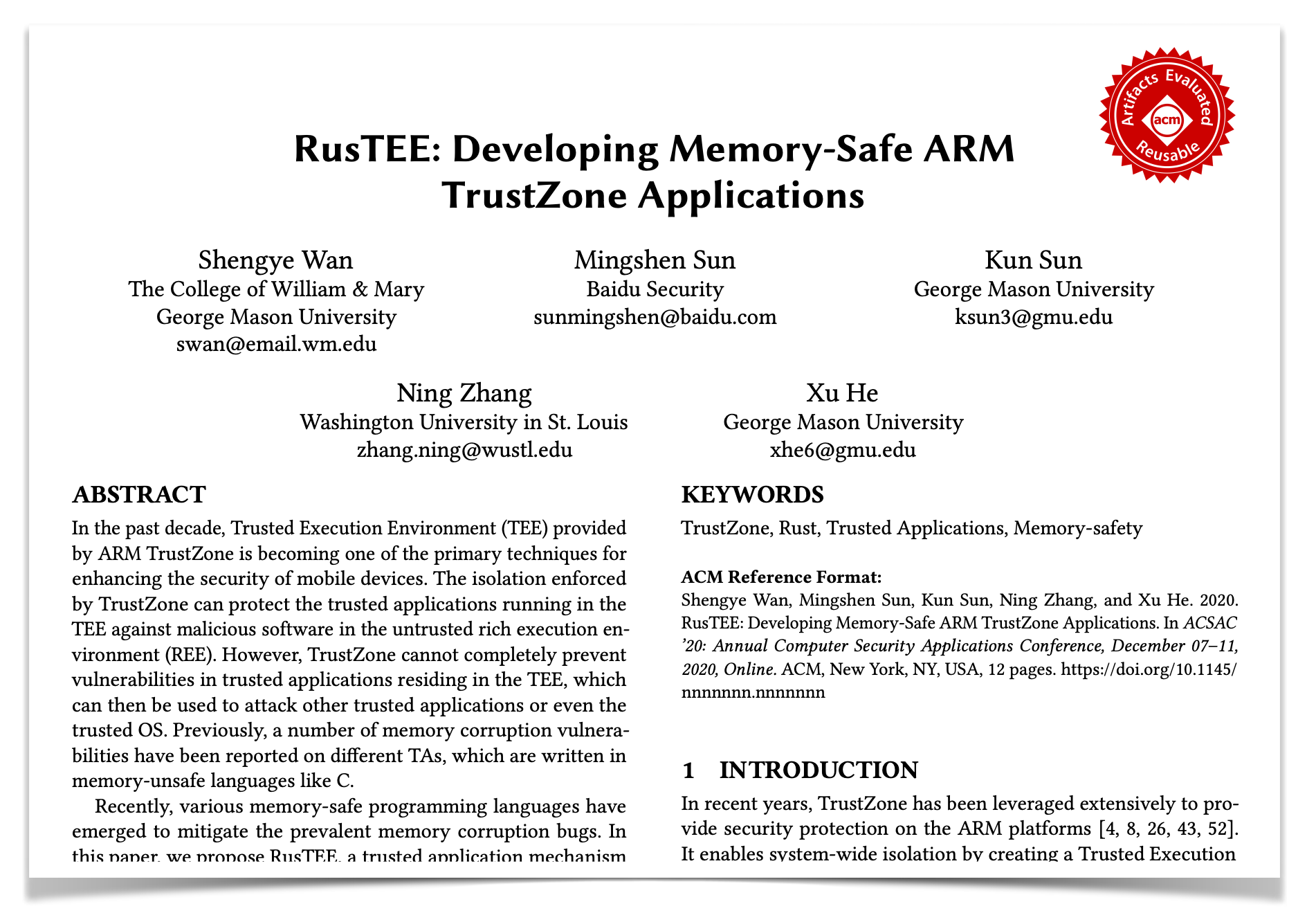
Teaclave TrustZone SDK 的 API 都提供了对应的文档,在项目 Wiki 中,我们提供了一个 快速上手的例子,在 QEMU 模拟器中运行使用 TrustZone SDK 的 trusted app。链接如下: https://github.com/apache/incubator-teaclave-trustzone-sdk/wiki/Getting-started-with-OPTEE-for-QEMU-ARMv8 。更多关于 Teaclave TrustZone SDK 的设计和性能等都在论文 RusTEE: Developing Memory-Safe ARM TrustZone Applications 中找到,此论文也收录于 ACSAC 2020。

Teaclave TrustZone Paper

Teaclave TrustZone SDK 时间线

  • 2019 年初开源。
  • 2019 年在 Linaro Connect 和 RustCon Asia 对外发布,得到了 ARM 的支持,现在其隐私计算相关项目中使用。
  • 2020 年相关文章发表在国际顶级安全会议 ACSAC,得到学术界肯定。
  • 随着隐私安全计算的发展,多个开源项目开始使用,例如由 ARM Research 主导的 Veracruz 开源项目使用 SDK 构建其隐私计算试验项目,Veracurz 也将加入隐私计算联盟(Confidential Computing Consortium)。
  • 2021 年 2 月升级 TrustZone SDK 支持 OP-TEE 3.11 和 3.12。
  • 2021 年 2 月启动项目捐赠流程,通过社区投票并提交 Software Grant Agreement。
  • 2021 年 3 月项目 repository 正式移交到 Apache 组织下,隶属于 Apache Teaclave (incubating) 项目。

Teacalve TrustZone SDK Timeline

Teaclave 开源社区

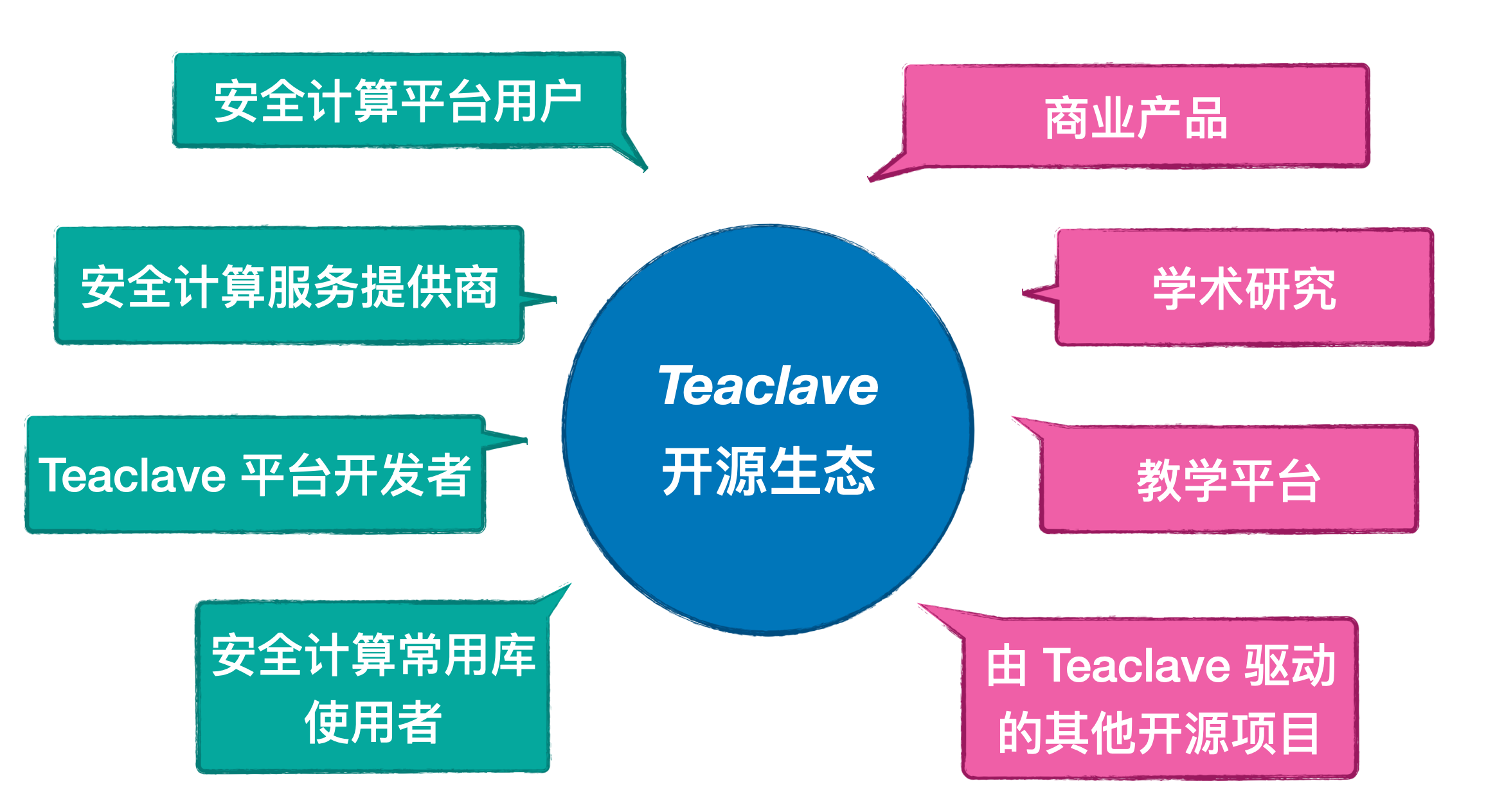
TrustZone SDK 加入 Apache 后,将与 Teaclave 开源社区共同发展,非常欢迎大家的贡献, 一起推动隐私安全计算生态 。已有至少四家公司或组织在产品中使用 Teaclave,并且有超 过九个开源项目使用了 Teaclave 平台和 Teaclave SGX SDK。这些都给项目的发展提供源 源不断的动力。更多信息可以在我们的官网 community 下查看: https://teaclave.apache.org/community/

Teaclave Commmunity

Teaclave 的开源是 The Apache Way (https://www.apache.org/theapacheway/) 的开源,无论是代码、文档、设计还是路线图规划,我们都会在社区的各个渠道中讨论。如 果 你想关注 Teaclave,亦或想加入我们的讨论,可以在 Github issues,邮件列 表 回复我们、发起新的话题。也可以关注我们的 Twitter 账号 @ApacheTeaclave了解最新动态。除此之外, 我们在官网 (https://teaclave.apache.org/)中提供了 Teaclave 相关的演讲、论文和文章,包括 TrustZone SDK 之前的演讲 slides 以及视频。

参考链接:

[1] Qualcomm's Secure Execution Environment (QSEE) privilege escalation vulnerability and exploit (CVE-2015-6639) : http://bits-please.blogspot.com/2016/05/qsee-privilege-escalation-vulnerability.html

[2] Extracting Qualcomm's KeyMaster Keys - Breaking Android Full Disk Encryption: http://bits-please.blogspot.com/2016/06/extracting-qualcomms-keymaster-keys.html

Welcome Rust OP-TEE TrustZone SDK to Teaclave

Mingshen Sun

English | 中文

TrustZone is a security feature by ARM SoC to provide a trusted execution environment to protect areas like mobile computing, edge computing, and emerging confidential computing, supporting scenarios like payments, key management, model protection, etc. However, one major security threat in TrustZone applications is the memory safety issue. For instance, a vulnerability of Qualcomm's QSEE is caused by the memory safety issue [1]. Attackers can even get the full-disk encryption key by exploiting such kind of vulnerability [2].

In 2019, Baidu open sourced the Rust OP-TEE TrustZone SDK project, enabling safe, functional, and ergonomic development of TrustZone app developments. The SDK provides a safer APIs based on the GlobalPlatform's TEE standard. In addition, Rust OP-TEE TrustZone SDK also support Rust's standard library and third-party crates (i.e., libraries). This will improve the efficiency of developments of TrustZone apps, and also extend its usage scenarios.

To accelerate the development of confidential computing ecosystem and improve TrustZone's foundation, Baidu has donated Rust OP-TEE TrustZone SDK to Apache Software Foundation as a subproject of Teaclave, and renamed it as Teaclave TrustZone SDK. The location of new repository is https://github.com/apache/incubator-teaclave-trustzone-sdk. Similar to Teaclave SGX SDK, Teaclave TrustZone SDK will be the foundation of Teaclave FaaS platform to support multiple trusted execution environments.

Design and Implementation of Teaclave TrustZone SDK

Based on the GlobalPlatform's C APIs, Teaclave TrustZone SDK provides safer Rust interfaces. With the SDK, TrustZone apps will not be affected by any memory safety issues caused by the Rust's strong type system.

Teaclave TrustZone SDK Design

We also created procedure macros to help developments. For example, developers can simply put #[ta_create], #[ta_open_session], #[ta_close_session], #[ta_destory], and #[ta_invoke_command] annotations before corresponding functions. These annotations will automatically generate helper functions to bridge the normal/secure worlds.

Teaclave TrustZone SDK Macros

By using the rich type system of Rust, the memory safety issues will be reported at compile time. For example, in the following case, compared to C's APIs, the Rust APIs have clearer semantics and more strict type checking.

Teaclave TrustZone SDK APIs

The project also has 13 samples, including encryption/decryption, secure storage, HOTP, etc. Also, we provide a message passing sample code by using serde for serialization and de-serialization between different worlds to avoid any security issues caused by improper design in boundaries.

Getting Started and Documentations

All APIs in Teaclave TrustZone SDK are well documented. In the project's Wiki page, we have a quick-start document to guide you compiling and running a TrustZone app in QEMU emulators. You can find more design and performance evaluation in our paper published in ACSAC 2020.

Teaclave TrustZone Paper

Teaclave TrustZone SDK Timeline

  • 2019: Open source.
  • 2019: Talks in Linaro Connect and RustCon Asia.
  • 2020: Technical report published in ACSAC 2020.
  • 2020: Many open source projects started to use the SDK. E.g., Veracruz by ARM Research is an experimental projects on confidential computing using the SDK.
  • Feb 2021: Support OP-TEE 3.11 and 3.12.
  • Feb 2021: Initial the donation procedure.
  • Mar 2021: Officially transferred to Teaclave.

Teacalve TrustZone SDK Timeline

References:

[1] Qualcomm's Secure Execution Environment (QSEE) privilege escalation vulnerability and exploit (CVE-2015-6639) : http://bits-please.blogspot.com/2016/05/qsee-privilege-escalation-vulnerability.html

[2] Extracting Qualcomm's KeyMaster Keys - Breaking Android Full Disk Encryption: http://bits-please.blogspot.com/2016/06/extracting-qualcomms-keymaster-keys.html